

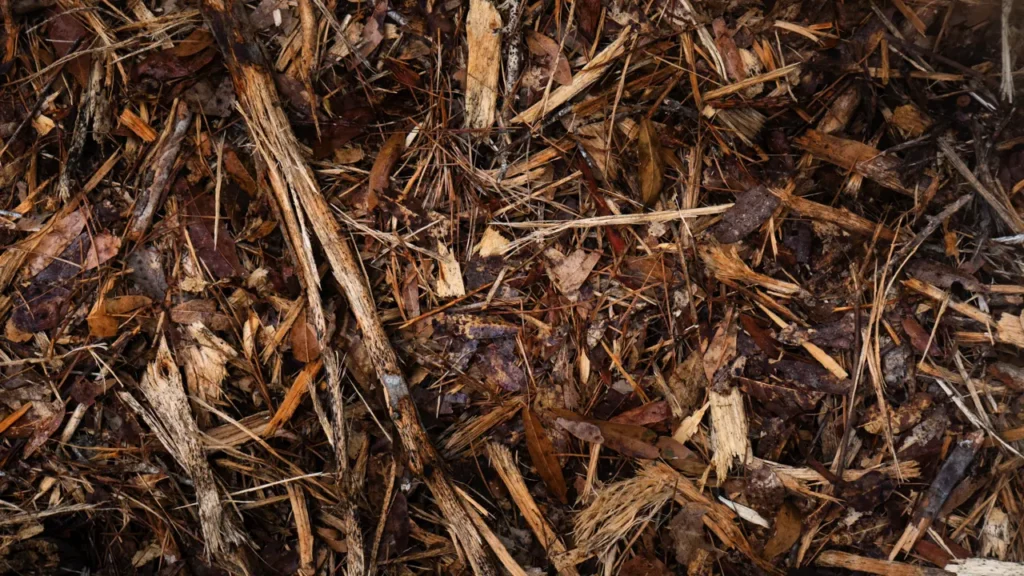
One machine goes in, grinds the undergrowth and small trees where they stand, and leaves the material on your ground as mulch. No burn pile. No trucks. No stump field to deal with afterwards.
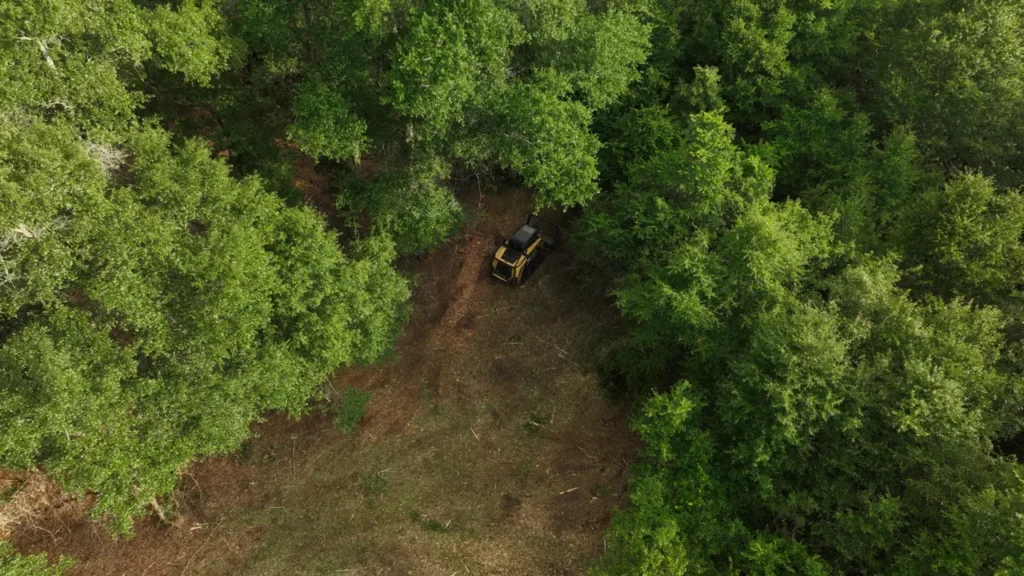
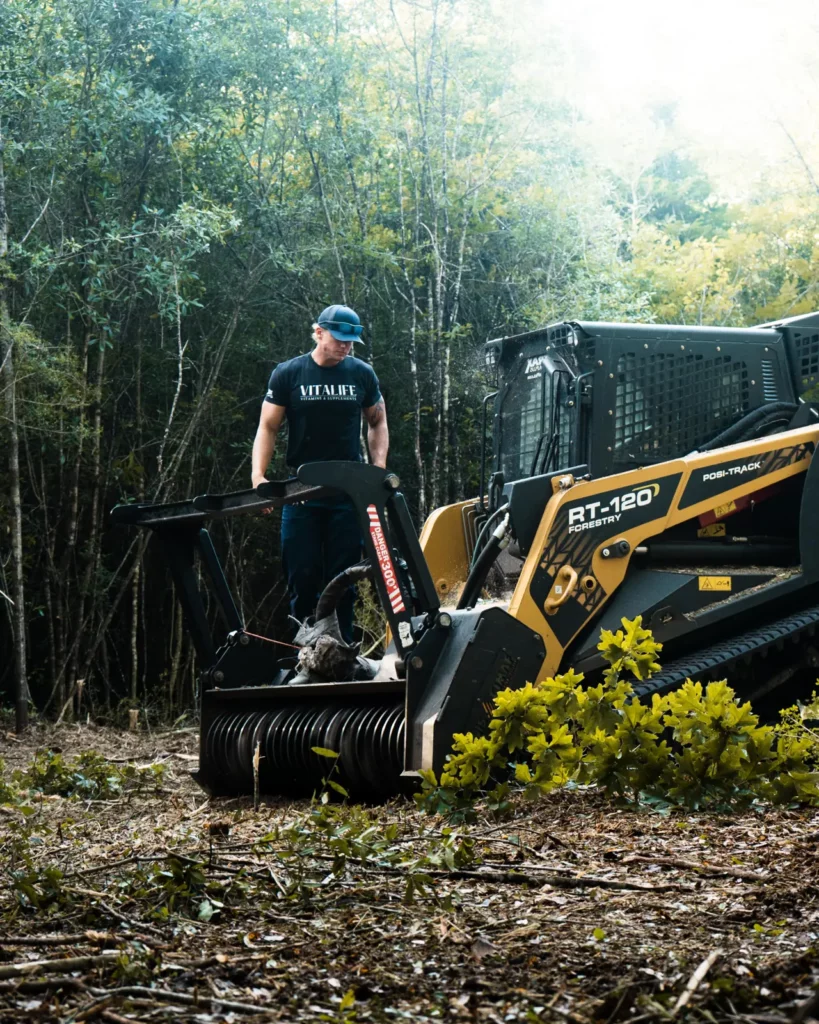
A mulching head is a steel drum with carbide teeth on it, mounted on the front of a tracked machine. It grinds standing vegetation from the top down and puts the chips on the ground. Small trees, brush, briar, vine, saplings, it goes through the whole understory in one pass and you’re left with an open, walkable stand of whatever you told us to keep.
The difference from traditional clearing isn’t the cutting. It’s the handling. Conventional clearing pushes everything into piles, deals with the root plates, and then you’re either burning it under a permit you hold or windrowing it into a pile. Mulching skips all of that, which is why it usually costs about half.
Keeping the mature pines and hardwoods and clearing everything underneath.
The mulch layer holds the soil. Bare-scraped ground on any kind of slope in this county will move in the first serious rain.
Neighbours, a fire ban, or a parcel too small to burn safely.
You’re clearing for access, a survey, a fence line or a food plot rather than for a foundation.
Mulched ground can be walked, driven and mowed the same afternoon.
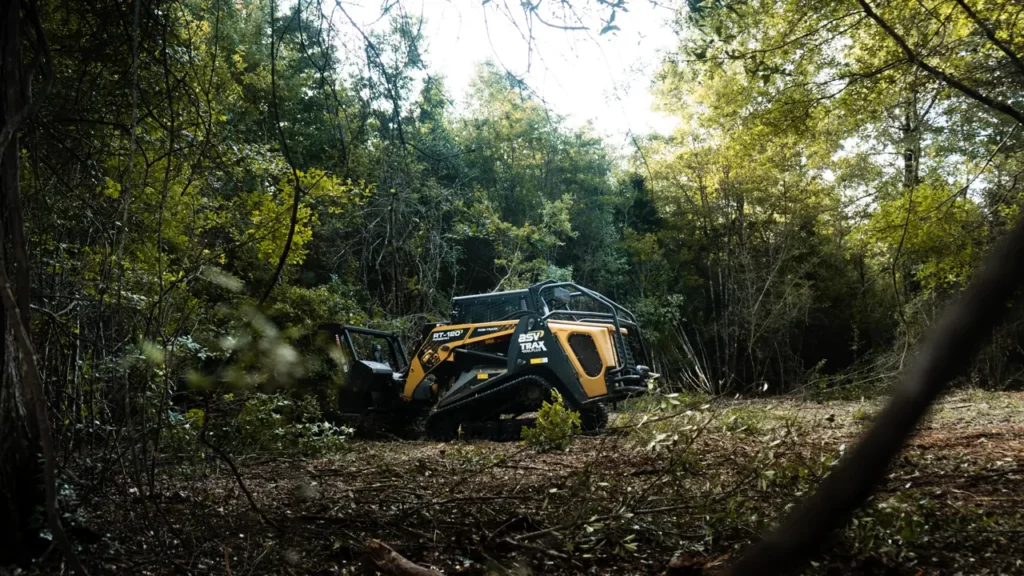
A building pad needs the stumps and root plates out and the ground graded. Mulching leaves the stumps in the ground. That’s lot clearing and site prep.
A heavy machine on soft ground leaves ruts that will still be there in two years. When it’s wet we’ll either wait or do a lighter underbrush pass instead.
Above about seven inches you’re better off felling first, and that changes the job.
A heavy mulch layer ties up nitrogen as it breaks down.
Everybody asks about acreage. Acreage is the smaller factor. Five acres of old pasture with scattered scrub is a faster job than one acre of twenty-year Chinese privet with greenbrier through it, and privet is what is actually growing on a great deal of unmaintained land in this county.
| Density | Per acre | Rough production |
|---|---|---|
| Light: grass, briar, saplings under 2 in | $1,500-$2,000 | 1.5-3 acres a day |
| Moderate: continuous understory, stems to 4 in | $2,000-$2,600 | 0.75-1.5 acres a day |
| Heavy: dense privet or titi, stems to 6 in | $2,600-$3,000 | 0.5-1 acre a day |
| Severe: hardwood thicket, blowdown, soft ground | $3,000-$3,400 | Under half an acre a day |
Between November and March the leaves are off, so we can see what we’re working with and so can you. The ground is firmer. Snakes are down. Visibility through the stand is better, which means less damage to the trees you’re keeping and a finer, more even chip. It’s also the opposite of the landscaping calendar, which is why winter is a quieter and often faster time to book clearing work.
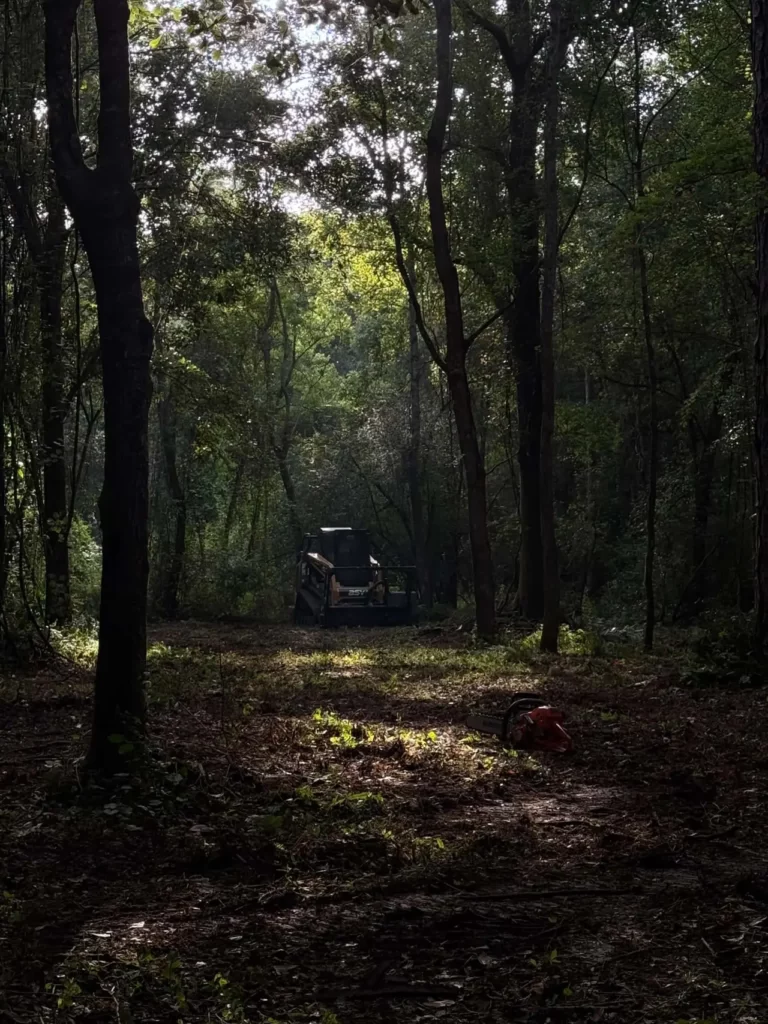
We do not sell, deliver or spread bagged or bulk mulch, and we don’t do decorative beds. Forestry mulching is a land clearing method, the material is your own vegetation ground in place. If you want mulch delivered for flower beds, you want a landscape supplier, and we’re happy to point you at one.
Usually three to six inches, depending on how much material was standing there. On very heavy ground it can be deeper, and we’ll spread it out rather than leave it windrowed.
Some of it will. Mulching cuts at ground level rather than taking the root out, so anything that stump-sprouts, privet, sweetgum, chinaberry, will come again. The mulch layer suppresses it for a season or two. Most people re-cut at twelve to eighteen months and it’s a fraction of the first clear. That’s maintenance cutting and we’ll put you on a reminder if you want.
That’s the main reason people choose mulching. Mark what stays, flagging tape or paint, or walk it with us and point, and we work around it. It’s slower than clearing everything, and it’s worth it if you want shade in five years.
Usually not, because it’s not a land disturbance in the regulatory sense, nothing is grubbed and no soil is moved. That changes near wetlands or if you’re in a jurisdiction with tree protection rules. See the permit guide and confirm with the jurisdiction.
Anywhere from under half an acre to three acres. It is entirely about density. We give you a machine-day count in the written quote after we’ve walked it.
Call and you get John Williams, not an answering service and not a dispatcher. If it’s after hours or a Sunday, send the form and you’ll have a text back and a callback first thing.