Land clearing and demolition permits in Mobile County

Home/Resources/Permits

Which office you deal with, when a permit is likely needed, and the two things that catch people out. No competitor in this county publishes anything on this at all.

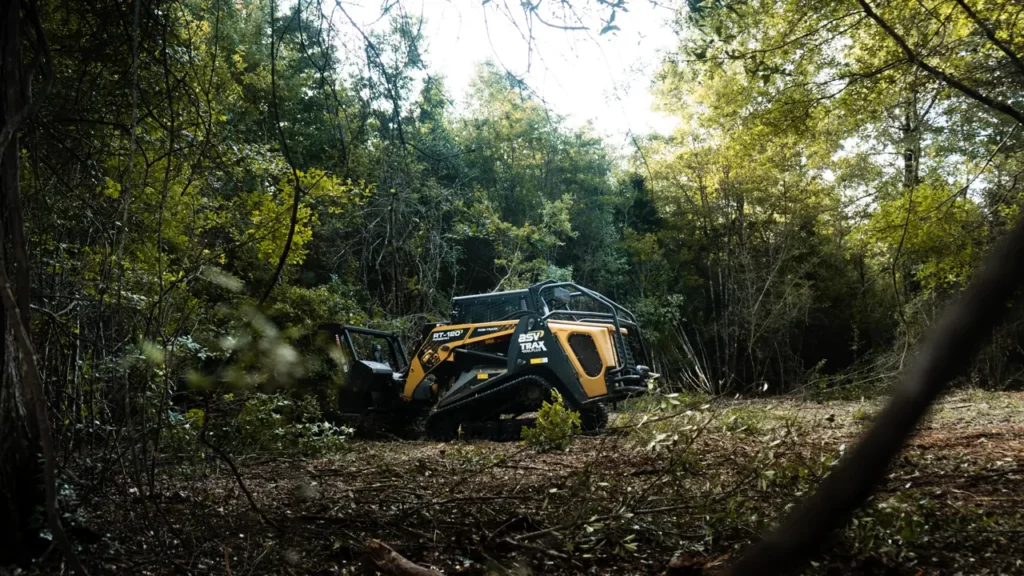
Forestry mulcher opening up a wooded lot, cleared ground in front
Read this first

This is general information written by a contractor, not legal advice and not an official source. Requirements change, jurisdictions differ, and your specific parcel may have conditions on it that no general guide can anticipate. Always confirm with the permitting office that actually has jurisdiction over your property before you clear anything. See our disclaimer.

First question: who has jurisdiction?

This is the thing people get wrong, and in Mobile County it’s genuinely confusing because the municipal boundaries are irregular and annexation has moved them over the years. Two parcels a mile apart on the same road can answer to different offices.

If your property is…You’re generally dealing with
Inside the City of Mobile limitsThe City of Mobile’s permitting office
Inside another incorporated municipality, Semmes, Saraland, Satsuma, Citronelle, Bayou La Batre, Mount Vernon, Creola, Chickasaw, PrichardThat municipality’s own permitting office
Unincorporated Mobile County: Theodore, Tillmans Corner, Wilmer, Grand Bay, Irvington, St. Elmo, Chunchula, Axis, Dawes, Kushla, Tanner-WilliamsMobile County
Anywhere, with wetlands or regulated waters on itFederal jurisdiction applies in addition to whoever else is involved

If you aren’t certain which side of a line your parcel falls on, the county’s parcel viewer or a call to either office will settle it in a few minutes. Do that before you assume.

When a permit is likely to be needed

Land disturbance above a threshold area.

Thresholds vary by jurisdiction, ask what applies to yours.

Work in or near wetlands or regulated waters.

Federal, and separate from anything local.

Work in a floodplain.

Additional requirements typically apply.

Open burning of debris.

Separate permitting, with conditions attached.

Anywhere a covenant, easement or conservation agreement applies.

Not a public permit, but a private restriction that binds you all the same.

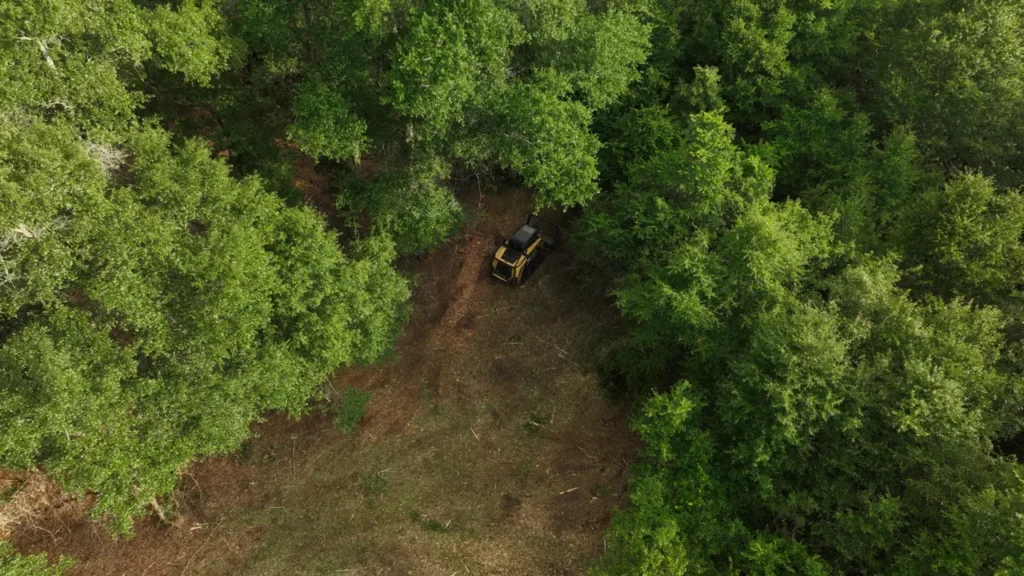
Drone view looking straight down on the mulcher in a fresh clearing

When it's usually simpler

Forestry mulching often falls outside land disturbance permitting because nothing is grubbed and no soil is moved, the vegetation is ground where it stands and the layer stays put. That’s a general tendency, not a rule, and it does not hold near wetlands or where tree protection ordinances apply. Ask.

The two things that catch people out

Wetlands

This is coastal Alabama. Wet-weather branches, seasonal ponds, sloughs and Delta-adjacent ground are common across this county, and a great deal of it is not obviously wet in August. Clearing regulated wetland without authorisation is a federal matter with consequences that dwarf the cost of the clearing job.

Signs worth taking seriously on your own parcel: standing water at any time of year, a defined channel or drainage, cypress or tupelo, ground that stays soft when everything around it is dry. None of those is a determination, only a qualified delineation is, but any of them is a reason to ask before you clear.


Open burning

If clearing debris is going to be burned, that’s separate permitting with conditions attached, and the permit is held by the landowner rather than the contractor. Worth settling before the job rather than after, because the alternative, windrowing the material into a pile on your property, changes where you want that pile to be.

Other things worth checking on your parcel

Call Alabama 811 before any ground disturbance.

Free, and required. Give it the statutory notice period.

Private utilities aren't marked by 811.

Irrigation, invisible fence, a run to a shed, well and septic lines. Only you know where those are.

Subdivision covenants.

Tree removal restrictions are common and are enforced privately, not by the county.

Conservation easements and cost-share agreements.

If your land is in a forestry program, mechanical work may be restricted.

Historic districts.

Additional review for demolition.

Cemeteries and burial sites.

More common on rural family land in this region than people expect, and protected.

What we do and don't do

We work to a permit you hold. We’ll tell you when we think you need one, and we’ll flag wetland concerns before we quote rather than after we’ve started. We don’t pull permits on your behalf and we won’t clear a parcel we think needs authorisation it doesn’t have, not to be awkward, but because the exposure lands on you as the landowner and it’s not worth it.

Ask about your parcel

Hours
Mon-Sat 6:00am-5:00pm
Closed Sunday
Minimum job
$1,000
What happens
Text back in 5 minutes · callback in 15 · we walk your property inside 48 hours · fixed written price inside 24 hours of that.
Six fields, 40 seconds

Tell us what's on the ground. We'll come look at it.

Call and you get John Williams, not an answering service and not a dispatcher. If it’s after hours or a Sunday, send the form and you’ll have a text back and a callback first thing.

Before you call

Have ready
The property address or parcel number, roughly how many acres you want opened, and what's growing on it: pines, hardwood, scrub, privet.
Don't have that?
Call anyway. We can pull it up on the county parcel viewer while we're on the phone.
Smallest job we take
$1,000
Out of state
$1,500 minimum in Mississippi.
Hours
Mon-Sat 6:00am-5:00pm · Closed Sunday