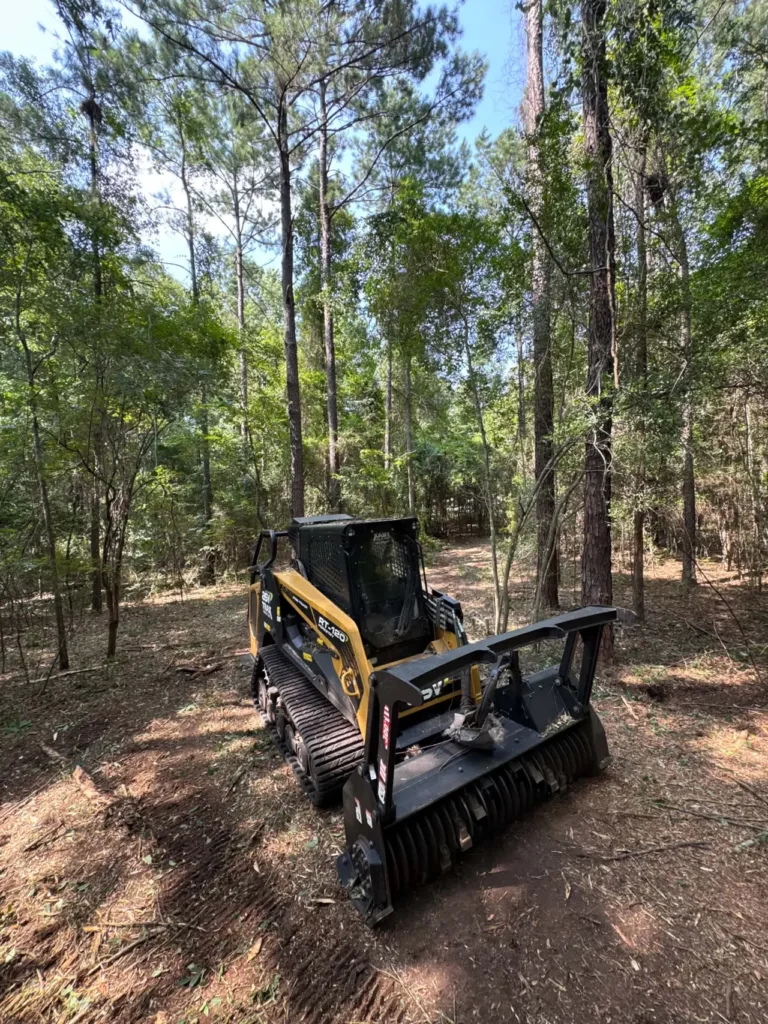
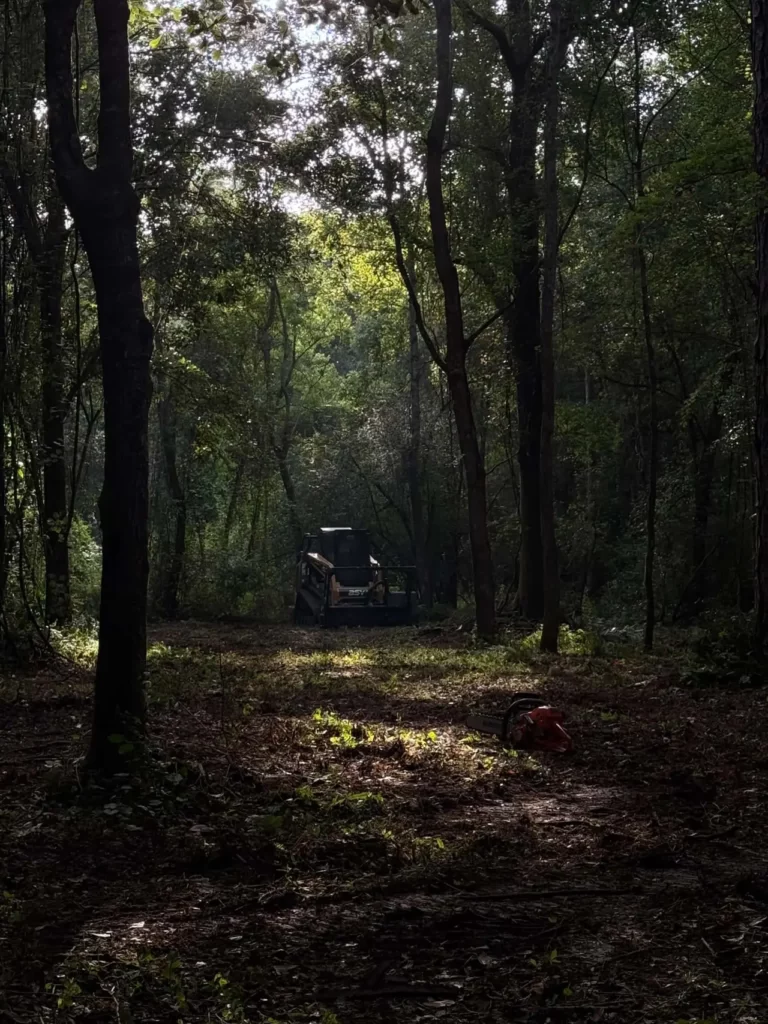
Taking stems out of a crowded stand so the ones you’re keeping have room, light and water. We take this work selectively, and we’ll be honest about when a forester should be involved instead.
Timber thinning done badly is worse than not thinning at all, you can damage the residual stand, take the wrong stems, and lose value you won’t get back for twenty years. On anything with real timber value, talk to a consulting forester or the Alabama Forestry Commission before you talk to any contractor, including us. Both are free or close to it, and they work for you rather than for the machine.
Pre-commercial thinning on a young stand that’s too dense and has no merchantable value yet.
taking competing hardwood and scrub out from around pine you’re growing on.
Small tracts that a commercial thinning operation won’t come out for.
Thinning to a plan your forester has already written. Send us the prescription and we’ll work to it.
tops, slash and residual scrub.
That’s a logging operation with feller-bunchers, skidders and log trucks. Different scale entirely.
Anything under a cost-share agreement or a conservation easement without the agreement in front of us first, those documents restrict mechanical work in ways that aren’t obvious and the exposure lands on you.
We’ll execute a marked or prescribed thinning. We won’t decide your silviculture for you.
An open stand with the residual trees standing clear, and the removed material mulched down or windrowed on site. No haul-off. On a young stand the mulch layer breaks down over a few years and returns organic matter to what is, across most of this coast, fairly sandy soil.
If the stand has merchantable value, yes, and it will pay for itself. If it’s a young dense stand with no sale value, a straightforward pre-commercial thinning is well within what we do.
No. You mark them, or your forester does, and we take what’s marked. Deciding which stems come out is a silvicultural judgement and it isn’t ours to make.
Not usually: pre-commercial thinning by definition produces material with no sale value. If there’s saleable timber in the stand, get a forester involved before anyone puts a machine in it.
Mulched where the machine can process it, windrowed where it can’t. We don’t haul it off.
Call and you get John Williams, not an answering service and not a dispatcher. If it’s after hours or a Sunday, send the form and you’ll have a text back and a callback first thing.