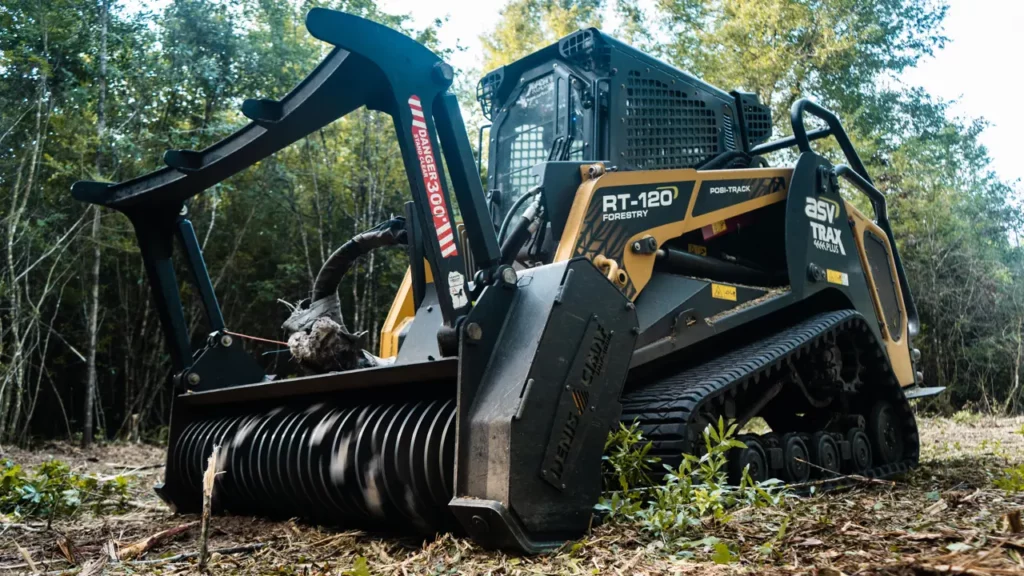
The real ranges, what moves them, and why the number you were quoted over the phone was almost certainly wrong.
| Method | Per acre | What you get |
|---|---|---|
| Forestry mulching, light | $1,500-$2,000 | Understory ground in place, mulch layer left down |
| Forestry mulching, moderate | $2,000-$2,600 | Same, denser material, slower going |
| Forestry mulching, heavy | $2,600-$3,000 | Dense privet or titi, stems to 6 in |
| Forestry mulching, severe | $3,000-$3,400 | Hardwood thicket, blowdown, soft ground |
| Full clearing to bare dirt | $3,000-$6,000 | Stumps and root plates out, debris handled, ground grubbed |
| Underbrush clearing (stand you’re keeping) | $1,500-$2,000 | Light-density mulching under retained trees |

Because per-acre pricing is a convenient fiction. What a contractor is actually selling you is machine-hours, and how many hours an acre takes varies by a factor of five or more depending on what’s standing there.
Not acreage. Not distance. Density. Five acres of old pasture with scattered scrub is a faster job than one acre of twenty-year Chinese privet with greenbrier running through it, and privet is what’s actually growing on an enormous amount of unmaintained land in south Alabama.
This is the difference between mulching and clearing, and it’s usually a factor of two. Mulching grinds it and leaves it on the ground. Clearing means piling it, dealing with the root plates, and then either burning under a permit or trucking it to a facility and paying a tipping fee per ton. The cutting is a fraction of the work; the handling is the job.
A mulching head handles stems up to about seven inches. Above that, production falls off sharply and at some point felling first becomes the sensible approach, which changes the job and the price.
Soft ground slows everything and risks rutting the property. In coastal Alabama that’s a seasonal reality, not an edge case. A job that takes a day in February can take two in July after a wet week.
Getting the machine to the work is real cost. If the machine can’t reach it without cutting a path first, the path is part of the job. And every contractor has a floor below which a job doesn’t pay, ours is $1,000, and anyone who doesn’t have one either isn’t telling you or isn’t in business long.
Working around retained trees is slower than clearing everything. It’s also usually the right call if you want shade in five years.
Three quotes for a clearing job routinely come back thousands apart, and it’s usually because they’re quoting different work. Check all of these:
Left as mulch, burned under permit, or hauled off. This alone can double a price.
Mulching leaves them in the ground. Ask explicitly, and ask whether they’re ground or pulled, they’re different jobs.
Rough grade and a compacted pad to spec are different trades.
Total parcel or actual work area?
An hourly rate transfers all the risk to you.
Common in this trade, $300 to $800 as its own line.
Ask for the certificate. Any hesitation is an answer.
If one number is dramatically below the others, the usual explanation isn’t efficiency, it’s a narrower scope, an hourly arrangement that will grow, or no insurance. Ask what’s different before you assume you found a bargain.
These are our own published bands for Mobile County, Alabama, and they’re what we quote against. The full pricing page includes stumps, fence and survey lines, and driveway work. Almost nobody in this market publishes numbers at all, which is exactly why we do.
Call and you get John Williams, not an answering service and not a dispatcher. If it’s after hours or a Sunday, send the form and you’ll have a text back and a callback first thing.